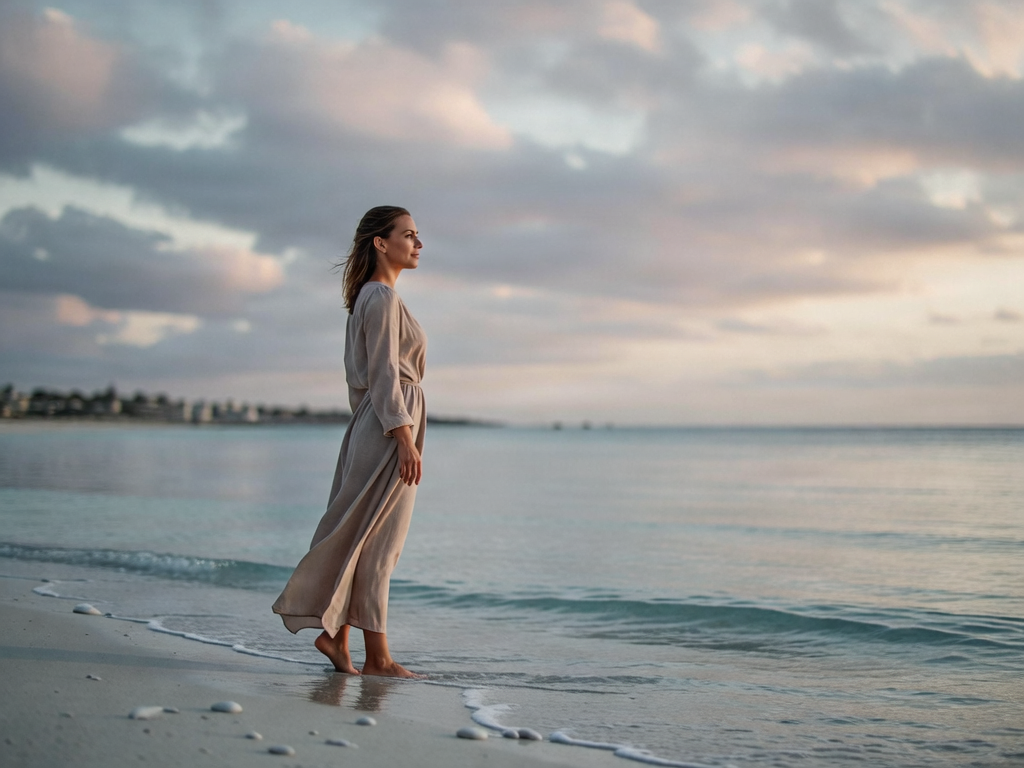
We arrive in Sahl Hasheesh after the concentrated visual life of Morocco: stone, shadow, tiled courtyards and the close choreography of a great hotel. At The Oberoi Beach Resort Red Sea coastline, the register changes. The horizon is wider, the palette quieter, and the day is marked less by spectacle than by the measured presence of water, light and open space.
This matters because a change of setting can alter the quality of attention. Not through any claim that a landscape itself can cure or transform, but because environment is one of the conditions in which a woman thinks, rests, decides and notices. For a woman who has spent years moving between boards, businesses, households, public roles and other people’s needs, the coast offers a useful counterpoint: a place where the immediate demands of the familiar are held at a respectful distance.
The Oberoi Beach Resort on the Red Sea Coastline
The Oberoi at Sahl Hasheesh forms the Egyptian chapter of Arc Vitae’s proposed 15-day private-jet Journey. It is not chosen as an interlude between more consequential destinations, nor as a conventional hotel stay dressed in the language of wellbeing. Its place in the route is more considered. After Madrid and Morocco, Egypt introduces a different kind of scale: sea beside desert, long sightlines, and a setting in which the body can be observed outside its usual tempo.
Arc Vitae is designed for women entering the chapter beyond achievement. Some may be considering a new enterprise, a changed family role, a more selective professional life or a question with no convenient name. None of these conditions is solved by leaving home for a fortnight. Yet distance can make patterns more legible, particularly when it sits within a longer engagement rather than being treated as an escape.
The Journey begins two months before travel. With Dorthe Hummel, clients populate the Living Blueprint through biological and genetic mapping, nervous system and hormonal analysis, and the health history held in Vitaspan, a patient-controlled Living Health Record. The point is not to produce a verdict on a woman’s health, and not to reduce her to a succession of scores. It is to establish context before a conversation becomes personal or a decision becomes practical.
By the time the group reaches the Red Sea, the questions being held are therefore particular. They may concern fluctuating energy, concentration under pressure, the cumulative effect of extensive travel, an established way of leading, or the gap between a woman’s public competence and the private conditions that sustain it. The coast does not provide the answer. It gives those questions room to be encountered without the usual noise around them.
A landscape within a Living Blueprint
The Living Blueprint is the central instrument of Arc Vitae. It is not a report, a diagnosis or a static test result. It is an evolving understanding of a client’s biological foundation, cognitive architecture, emotional landscape, environmental context, and purpose and direction. Vitaspan connects the records, results and history that a woman chooses to place under her control; Hummel’s mapping supplies the interpretation and substance.
The environmental dimension is often misunderstood as a matter of selecting the right products, routines or interior aesthetics. It is broader than that. It includes the settings that place demand on a woman, the rhythms that govern her days, the people and responsibilities around her, and the degree to which her surroundings allow for recovery, concentration or honest thought. A coastline is not inherently beneficial. Its relevance depends on what it reveals about the life to which she will return.
At The Oberoi Beach Resort, privacy is not merely a hospitality feature. Within the design of the Journey, it supports discretion. There is no requirement for a woman to perform renewal, disclose more than she wishes, or convert a period of reflection into a public narrative. The group is limited to twelve women, and the women travelling together will be at different points in their lives. What connects them is not a prescribed outcome but a willingness to examine the architecture of their next decades with greater precision.
Deborah Delaney’s role is to integrate the disciplines, the Blueprint and the lived experience of the route into one system. Her work across nutritional therapy, herbalism, hypnotherapy and NLP informs a methodology developed over 25 years, including 17 years in luxury hospitality. In this context, integration is the operative word. Biological information without behavioural understanding can become abstract. Reflection without evidence can become impressionistic. A luxurious setting without continuity is simply a pleasant setting.
The value of an unhurried interval
The Red Sea chapter is deliberately not framed as a pause from life. For women who carry substantial responsibility, that phrase can imply that ordinary life is an obstacle rather than the material to be understood. The purpose is closer to observation: to see how a woman arrives, how she responds when the pace changes, what becomes clearer when obligations are temporarily reorganised, and which assumptions remain intact.
There is also a distinction between rest and passivity. A quieter schedule may create the conditions for a more exact conversation, but it does not demand one. One woman may find that the coast clarifies a practical decision about work or family. Another may recognise that the useful information lies in a recurring response to uncertainty. For someone else, the value may be more modest: a renewed sense of the conditions under which she feels most steady, attentive and herself. Arc Vitae makes no promise that one landscape will produce a uniform result.
Eeva Jaakonsalo brings another lens to this work. Her experience advising Finnish executive teams and boards informs an understanding of how role, responsibility and relational dynamics shape a woman’s choices. For an accomplished woman, capacity is rarely only physiological. It is also influenced by the expectations she has learned to meet, the standards she applies to herself, and the identity she has built through being relied upon. These are not defects to be corrected. They are part of the pattern that the Blueprint is designed to hold.
The contrast between the shore at Sahl Hasheesh and the later Indian setting at Oberoi Rajgarh Palace is meaningful without being forced. Each location offers a distinct sensory and cultural context. The route does not use place as decoration. It uses movement, hospitality, history and changing environments to bring different dimensions of the Blueprint into view. A woman may notice different aspects of her attention beside the sea than in a city, a palace or a familiar office. That is an observation to examine, not a conclusion to romanticise.
What continues after the coast
No serious work on longevity can be compressed into a beautiful itinerary. The Journey is one part of a twelve-month engagement, followed by a month of post-Journey integration and continued revision of the Living Blueprint. Information gathered before travel, insights arising during it, and the realities of a woman’s return are held in relationship. The Blueprint changes because a life changes. New records, decisions, circumstances and understanding belong in the picture.
That continuity protects against a familiar error in personal development: mistaking a vivid moment for a durable shift. The intention is not that a woman returns with a perfected routine or a carefully staged new identity. She will leave with a more integrated body of information, language for what she has observed, and a framework through which to make choices that fit her actual life.
On the Red Sea coastline, the surface of the water will change through the day while the horizon remains in place. For a woman considering what deserves to remain and what is ready to change, that may be enough of a useful image: not reinvention, but a clearer line from which to proceed.