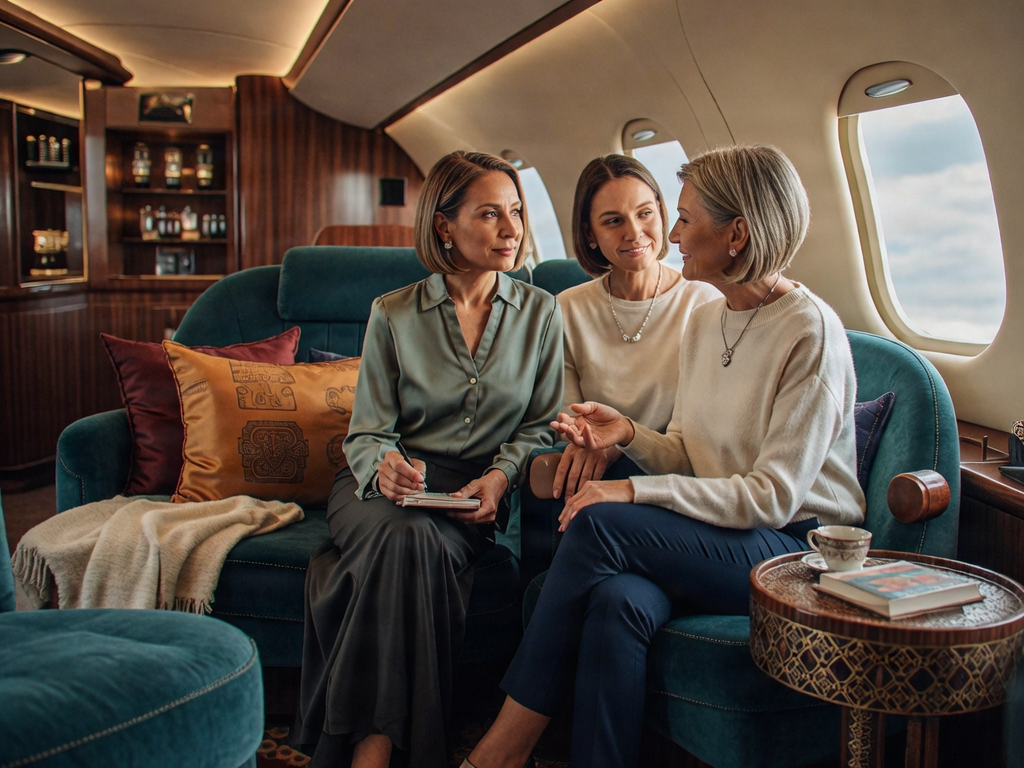
She has a full calendar, a capable team, and enough health data to fill a folder. Yet the question that persists is not whether she can do more. It is whether the life she has built still supports the woman she intends to become. A private jet wellness journey, thoughtfully designed, can create the rare conditions for that question to be examined with rigor rather than urgency.
For accomplished women, wellness is rarely a matter of finding another protocol. Many already understand nutrition, movement, sleep, and the value of excellent medical care. What is harder to find is a coherent view: one that accounts for biology and genetics, cognitive demands, nervous-system patterns, relationships, physical surroundings, and the particular responsibilities that shape a life.
That distinction changes the role of travel. The journey is not an escape from reality, nor a luxury backdrop for a list of interventions. It is a protected period in which the usual signals of performance and obligation recede enough for more useful intelligence to emerge.
Why a private jet wellness journey needs a purpose
Private aviation can be reduced to convenience. In this context, its greater value is continuity. A small cohort can move between distinct environments without the fatigue, exposure, and fragmentation that commercial travel often introduces. Time that would otherwise be lost to terminals, delays, and logistical negotiation remains available for rest, reflection, faculty conversation, and the quieter work of noticing what the body has been communicating.
Privacy matters just as much. Women who lead companies, families, institutions, and public-facing lives are accustomed to being observed and needed. A carefully held group of twelve creates another kind of social space: discreet, intelligent, and free from the demand to perform competence. The point is not confession. It is the ability to consider one’s life without having to manage the room.
Still, the aircraft is not the intervention. It is the connective tissue. The quality of a private jet wellness journey depends on what it connects: credible diagnostics before departure, environments selected for their different demands and restorative qualities, a consistent faculty, and a framework that continues after the journey ends.
From health information to personal intelligence
A laboratory value can be accurate and still be incomplete. So can a genetic finding, a wearable trend, or a carefully completed questionnaire. None can explain, on its own, why a woman whose health markers appear acceptable may feel less resilient, less focused, or strangely detached from the life she has worked hard to create.
Arc Vitae begins with a broader premise. Longevity is not a static condition to be measured once. It is an evolving system, shaped by biological inheritance and current physiology, but also by stress exposure, decision load, sensory environment, relationships, purpose, and the rhythms of daily life.
Two months of pre-journey work are designed to establish this context through Vitaspan data, personal medical history, behavioral patterns, and a close reading of each woman’s present chapter. Biological Intelligence considers the body with appropriate clinical seriousness: genetics, health markers, neuroscience, performance, and the patterns that may influence energy, recovery, and cognitive capacity. It does not promise certainty where medicine cannot offer it.
Sensory Intelligence asks another set of questions. How does a woman’s nervous system respond to sound, pace, light, social density, beauty, stillness, or constant access? What restores her attention, and what quietly drains it? These observations are easily dismissed as preference. In fact, they may have material consequences for sleep, concentration, mood, and the ability to make clear choices.
Human Intelligence brings the social and strategic dimensions into view. A life is not lived inside biomarker ranges. It is lived in boardrooms, homes, partnerships, communities, and periods of transition. Leadership style, relational patterns, personal ambition, and the distance between stated priorities and actual commitments all belong in a serious account of well-being.
The result is the Living Blueprint: not a report, an app, or a fixed set of instructions, but a dynamic understanding of a woman across biological, cognitive, emotional, environmental, and purpose dimensions. It is designed to evolve as her circumstances and insight evolve.
The architecture of the 15-day journey
The Arc Vitae Journey is designed as a 15-day private experience for a maximum of twelve women, traveling from Madrid through Morocco, Egypt, and India before returning to Madrid. Each location has a function beyond visual distinction. The movement between places is part of the method, offering a change in sensory and cultural context while the underlying inquiry remains consistent.
Madrid provides a considered point of arrival: a place to step out of the compressed pace of ordinary obligations and establish the group’s shared standards of privacy, curiosity, and attention. The journey then moves through Morocco, Egypt, and India, with stays at Mandarin Oriental and Oberoi properties selected not as spectacle, but for the calm, care, and spatial quality necessary for sustained work.
Different settings can reveal different habits. A woman who is fluent in managing every variable may notice her relationship to control more clearly when familiar routines fall away. Another may recognize that what she calls discipline is partly a response to chronic overstimulation. These are not predetermined discoveries, and they cannot be manufactured. The program is designed to make room for observation, with the right questions held nearby.
The journey will combine faculty-led conversations, individual reflection, restorative practices, cultural encounters, and periods without the pressure to turn every moment into output. The cadence matters. Intensity without integration becomes another form of strain; too much unstructured time can leave insight unexamined. The design seeks a more intelligent balance.
Faculty continuity, not rotating expertise
The same three faculty members guide the cohort across the full Arc Vitae experience. That consistency allows observations to build rather than reset at every location.
Deborah Delaney, founder of Arc Vitae, focuses on integration, environment, and continuity. Her work considers the conditions that allow an insight to survive reentry into a demanding life. Dorthe Hummel brings Biological Intelligence, including biological and genetic intelligence, neuroscience, and performance, to the personal patterns identified before and during the journey. Eeva Jaakonsalo brings strategy, leadership, executive development, and human dynamics, connecting individual clarity with the choices, relationships, and systems in which a woman operates.
Their disciplines are distinct, but they are not treated as separate tracks. A leadership pattern may have implications for nervous-system load. A biological finding may alter how a woman thinks about travel, recovery, workload, or the boundaries she has historically considered negotiable. The purpose is not to medicalize every life decision. It is to make decisions with a fuller understanding of their cost and consequence.
What happens after the plane lands
A concentrated journey can sharpen perception. It cannot, by itself, reorganize a woman’s calendar, relationships, work culture, or ingrained responses to pressure. This is where many high-end wellness experiences lose their value: the participant returns to the same conditions with a beautiful memory and no durable structure for interpretation.
Arc Vitae is designed differently. One month of post-journey faculty integration follows the travel period, allowing observations to be tested against ordinary life rather than admired in isolation. The Living Blueprint continues to be refined over twelve months through the secure datahealth wellness AI platform. Its role is not to replace judgment with technology. It is to hold relevant information together, so that patterns can be revisited as health, responsibilities, and priorities change.
The trade-off is deliberate. This approach asks more than attendance. It asks a woman to be candid about the life she has arranged, including the parts that have rewarded her while also depleting her. It also respects that not every answer requires dramatic change. Sometimes the most consequential adjustment is a new boundary, a different travel rhythm, a revised leadership habit, or a more exact understanding of what genuine restoration requires.
The most useful question to carry into a private jet wellness journey may be simple: what would become possible if your health intelligence were allowed to inform the architecture of your life, rather than compete with it?